



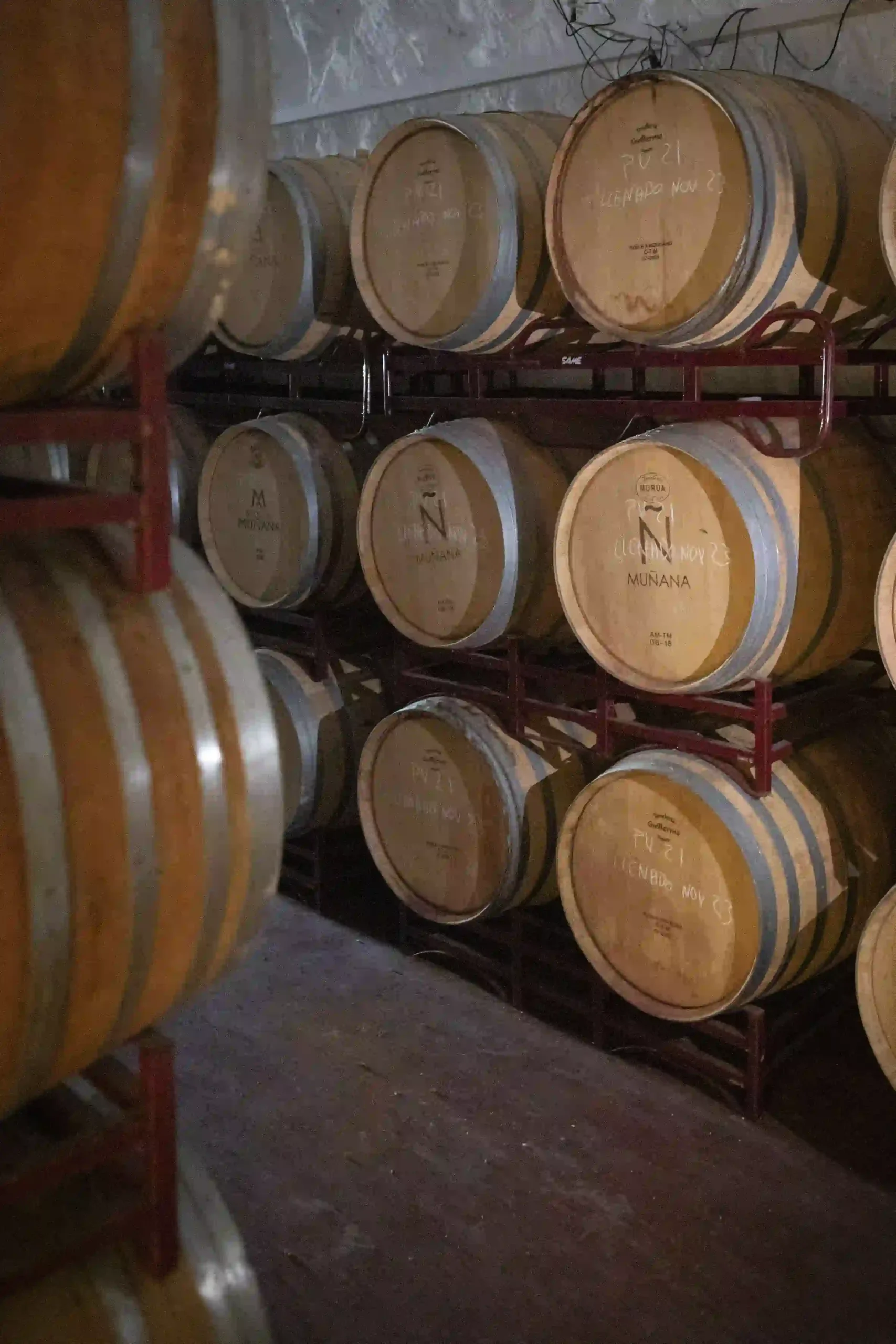
When you taste a red wine and perceive notes of vanilla, toast, coconut, cedar, or chocolate, you are drinking time itself. The time that wine has spent inside an oak barrel, in the darkness and silence of a cellar, slowly transforming into something more complex, rounder, and deeper than it was when it left fermentation.
The oak barrel It is one of the most influential—and most misunderstood—elements in the world of wine. It is not just a container for storing liquid: it is an active instrument of transformation that contributes compounds, allows for controlled micro-oxygenation, and irreversibly changes the structure and aromatic profile of the wine it contains. Understanding it is to understand a fundamental part of why great aged wines taste the way they do.
A barrel is a oval-shaped wooden container Made from staves—curved wooden boards—joined without nails or adhesives, held together only by metal hoops and the pressure they exert on one another. The oval shape is not arbitrary: it distributes the pressure of the liquid inside evenly and facilitates rolling to mix the wine without opening the barrel.
He oak (Quercus spp.) is the wood chosen for the production of wine barrels for very specific reasons that other woods do not simultaneously possess:
Controlled porosity: Oak has a cellular structure that allows for very slow and precise micro-oxygenation of the wine, without allowing the liquid to filter through.
Richness in aromatic compounds: Oak contains ellagic tannins, lactones (which give notes of coconut and vanilla), phenolic aldehydes (vanillin), toasted and spicy compounds that are progressively transferred to the wine
Workability: Oak wood is flexible enough to be bent with steam without breaking, allowing the characteristic oval shape of the barrel to be manufactured.
Durability: A well-maintained barrel can be used for 5 or more years, although its influence on the wine gradually diminishes with each use.
The barrel acts on the wine through three simultaneous and interrelated mechanisms:
Through the porosity of the wood, small amounts of oxygen from the outside penetrate the barrel and dissolve into the wine. This process, although slow, has profound consequences:
It softens the tannins: The tannins in wine react with oxygen and with each other in a polymerization process that makes them larger, softer, and less aggressive on the palate. The hard, astringent tannins of a young red wine transform, over time and through the micro-oxygenation of the barrel, into the silky, velvety texture of great reserve wines.
Stabilizes the color: Oxygen promotes reactions between anthocyanins (pigments) and tannins, creating more stable complexes that preserve the wine's color for longer.
Reduces perceived acidity: Controlled oxidation also softens the perception of acidity, making the wine rounder on the palate without eliminating the underlying freshness.
Wine, being a slightly acidic and alcoholic liquid, acts as a solvent that extracts compounds from the oak wood during aging. The main compounds that oak contributes to wine are:
Ellagic tannins: Unlike grape tannins (condensed tannins), ellagic tannins from oak contribute to the structure and complexity of wine, and have their own antioxidant properties.
Vanillin and phenolic aldehydes: Those responsible for the notes with vanilla so characteristic of aged wines, especially those aged in American oak
Oak lactones (whisky lactones): They provide notes on coconut, sweetwood and spices to the wine
Furans and pyrazines: Compounds that appear during the toasting of the barrel and contribute notes of coffee, toast, bread, caramel and spices (cloves, cinnamon)
Volatile phenols: Such as guaiacol and 4-methylphenol, which in moderate amounts contribute to notes of smoke, leather, and spice.
During the time the wine spends in barrels, a small amount evaporates through the wood. This loss—between 2 and 5% of the annual volume depending on the winery's conditions—is poetically called in winemaking tradition the "part of the angels" (the angels' share (in French).
This evaporation has a concentrating effect: water and alcohol evaporate in different proportions, which can slightly alter the wine's alcohol content and concentration. Wineries compensate for this loss by periodically topping up the barrels with the same wine to prevent the empty space from filling with air and oxidizing the wine.
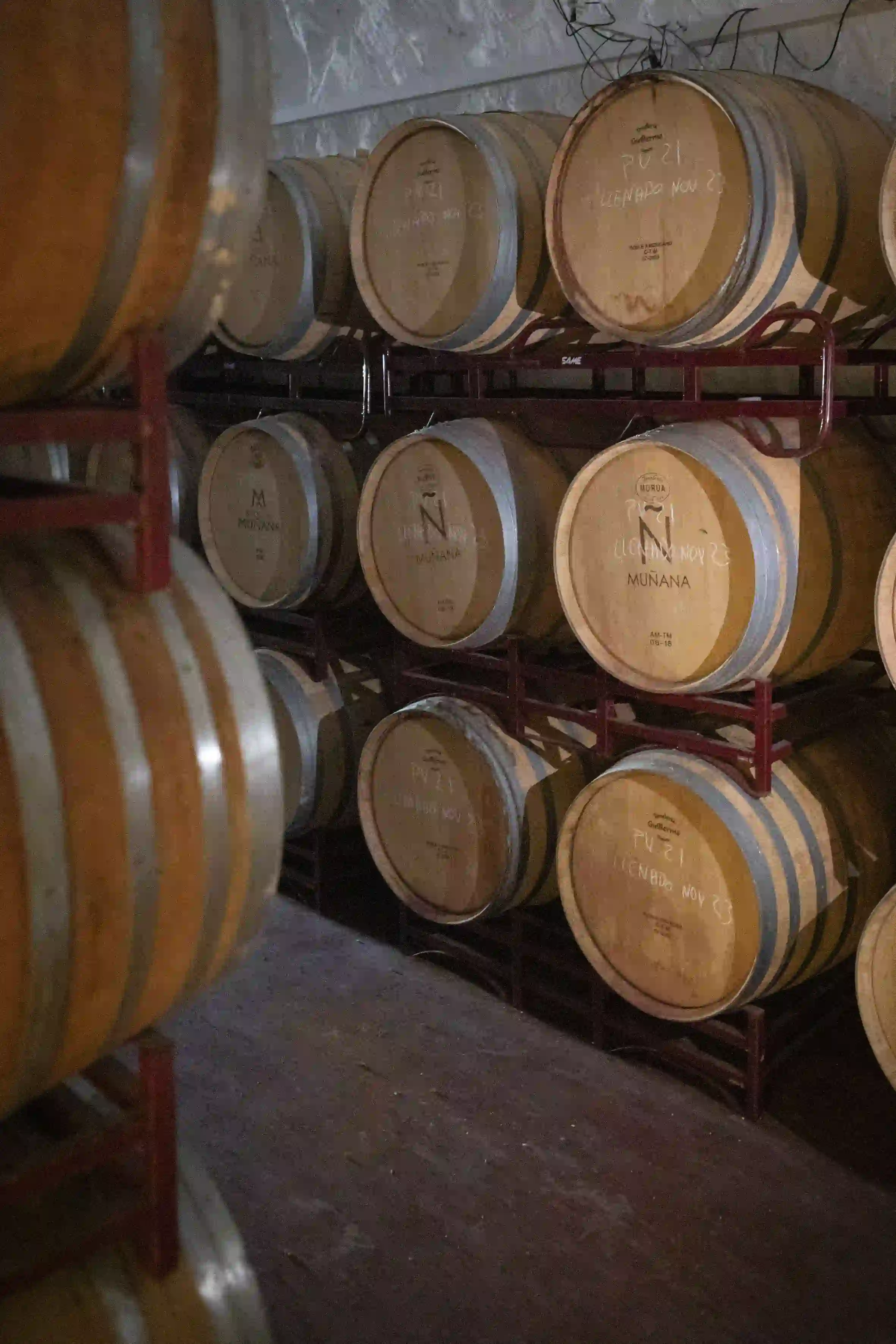
Not all oak barrels are the same. The two main families of oak used for barrels are... French oak and the American oakand their differences have a direct and very noticeable impact on the wine's profile:
The choice between French and American oak is one of the most important decisions for the winemaker, and many aged wines use it. mixtures of both types to achieve the desired balance between elegance and aromatic expressiveness.
He American oak It is the signature of the most classic Riojas: those reds with powerful notes of vanilla and coconut that are unmistakable and have defined the international style of Rioja for decades. French oak It provides a profile closer to Bordeaux and Burgundy: more subtle, more structured, with more complex aromas and a finer integration with the wine.
There are also other types of oak that are increasingly used:
Hungarian and Slovenian oak: A profile somewhere between French and American, increasingly popular for its value for money
Roble de Allier, Vosges, Nevers, Tronçais (French forests): Different origins of French oak with their own nuances; the most technical sommeliers distinguish between them
Before being used, the barrels are I support over direct heat during the manufacturing process. The heat bends the staves to give them their oval shape and, simultaneously, transforms the compounds in the surface wood, creating new aromatic compounds that will be transferred to the wine.
The level of toasting chosen by the barrel maker (cooper) has a direct impact on the profile that the barrel will impart to the wine:
Light Toast: It better preserves the natural aromas of oak (coconut, fresh vanilla, spices). It also adds more tannins to the wine. Recommended for aged white wines and wines where the aim is to retain the expression of the fruit.
Medium Toast: The most versatile and widely used. A balance between natural oak aromas and toasted notes. Hints of vanilla, sweet spices, and light toasting.
Medium-plus toast: More notes of coffee, caramel, chocolate, and spices. Reduces harsh oak tannins. Widely used in aged red wines with character.
Heavy Toast: Dominant aromas of coffee, charcoal, smoke, and dark chocolate. Very few oak tannins. For very powerful wines that need to integrate oak quickly.
The size of the barrel determines the relationship between wood surface area and wine volumewhich in turn controls the intensity of the oak's influence:
In the production of aged wines at Bodegas Muñana, we use 225-liter barrels—the classic size—for our 1188 range wines and the Muñana Roblewhere we seek a real integration between wine and wood, and larger volume containers for preparations where we want the terroir of Sierra Nevada to speak more clearly and the wood to act in the background.
A new barrel imparts the maximum amount of aromatic and tannic compounds to the wine. With each use, this contribution gradually decreases.
First use: Maximum contribution of oak aromas and tannins. Risk that the wood will overpower the fruit and terroir if the wine lacks sufficient structure.
2nd and 3rd use: Moderate, more balanced influence. A favorite of many modern winemakers seeking to integrate oak without it dominating.
4th and 5th use: Minimal aromatic contribution; the barrel functions primarily as a micro-oxygenation vessel
More than 5 uses: The barrel is practically aromatically neutral; it is used as an aging container without any addition of wood.
The great wines of Bordeaux and Burgundy mostly use new or first-use barrels for their best references, which partly explains their high prices: a quality new French oak barrel can cost between 600 and 900 euros, and with 225 liters and a yield of about 300 bottles, the cost per bottle just for the barrel ranges between 2 and 3 euros.
There is no universal answer: it depends on the type of wine, the grape variety, the vintage, and the winemaker's philosophy. However, there are general guidelines that Spanish regulations also include for aging categories:
Young wines without aging: Without oak aging or with very brief aging (1-3 months) in neutral containers
Wines aged in oak or "semi-aged": 3-6 months in oak barrels; this is the case of Muñana Roblewhere we seek to integrate the wood without losing the fruity expression and the character of the high altitude
Breeding: Minimum 6 months in barrel according to Spanish regulations for the category
Reservation: Minimum 12 months in oak barrels
Gran Reserva: Minimum 18 months in oak barrels
To understand in detail what each aging category entails and how time in oak barrels combines with bottle aging, we recommend our article on the Differences between crianza, reserva and gran reserva.
Barrel aging isn't exclusive to red wines. Some of the world's most complex and long-lived white wines are aged in barrels, although the process is different:
Barrel fermentation: The must ferments directly inside the barrel, rather than in a stainless steel tank. This produces a deeper integration between the wine and the wood, resulting in creamier textures and more complex aromas.
Aged on lees in barrels: After fermentation, the wine remains in contact with the remains of dead yeast cells (lees) inside the barrel, and is stirred periodically (batoningThe lees add creaminess and complexity, and protect the wine from excessive oxidation.
Great examples: The great Chardonnays of Burgundy (Meursault, Puligny-Montrachet, Chassagne-Montrachet), aged white Rioja wines, and the best Spanish high-altitude Chardonnays demonstrate that barrel-aged white wine can be as complex and long-lived as the best reds.
He Muñana 1188 Chardonnay It precisely expresses this philosophy: a high-altitude Chardonnay from Sierra Nevada aged in oak barrels that adds complexity and texture without losing the freshness and mineral tension that only the mountain vineyard provides.
When you taste a barrel-aged wine, there are specific descriptors that indicate the presence and intensity of the oak:
Aromas that indicate aging in American oak:
Intense vanilla, coconut, caramel, sweet wood, café au lait
Aromas that indicate aging in French oak:
Cedar, cigar box, dried spices (pepper, clove, cinnamon), subtle toasting, wet earth, dark chocolate
Intense toasted aromas (regardless of the origin of the oak):
Coffee, charcoal, smoky, smoke, roasted licorice
Textures that indicate barrel aging:
Softer and rounder tannins than in a young, unoaked wine.
Greater volume and unctuousness in the mouth
Longer and spicier ending
To learn how to systematically identify these cup descriptors, we recommend our guide on How to taste wine correctly And, to go a step further, our article on the phases of a wine tasting.
An oak barrel is not simply a container: it is a living ecosystem where wine and wood transform each other over months or years. Every stave, every level of toasting, every origin of the oak, every barrel size is a decision made by the winemaker that will be forever imprinted on the wine it contains.
At Bodegas Muñana, we use the barrel for what it is: an instrument at the service of the terroir, not the other way around. The altitude of the Sierra Nevada mountains and the character of our grape varieties—Tempranillo, Syrah, Cabernet Sauvignon, and Chardonnay—are the protagonists. The barrel is the frame that contains them, rounds them out, and prepares them to reveal their best selves. Our guiding principle is that when you uncork a bottle of Muñana, the first thing you experience is the mountain, not the wood.
Explore the wines of Bodegas Muñana, both barrel-aged and unoaked, in our online wine shop and see in the glass the difference that altitude, time and oak make together.
 Spanish Spanish
 English
 Chinese
Puedes realizar tus pedidos con normalidad hasta el 31 de julio.
Durante estas fechas no será posible tramitar pedidos. Volveremos a estar operativos el 16 de agosto.